Aerodynamic Performance and CdA
Time Trial, Triathlon, Aero Road, and Endurance Road Bicycles Compared
Why CdA matters more than bike marketing
When cyclists talk about aerodynamics, the most useful single metric is CdA. CdA is the product of drag coefficient (Cd) and frontal area (A), and it represents the aerodynamic drag of the entire system: rider, bike, helmet, clothing, wheels, bottles, and accessories.
At typical solo riding speeds — especially above about 25 km/h — aerodynamic drag is the dominant resistance. This is why CdA is far more informative than frame weight or tube shapes when comparing different types of bicycles.
This article compares four categories of bikes:
• A dedicated time trial (TT) bike
• A triathlon bike, the Argon 18 E-119 Tri+ Disc
• An aero road bike, the Trek Madone SL 7
• An endurance road bike, the Trek Domane SL 6 Gen 4
The goal is not to declare a “best” bike in isolation, but to explain why these bikes differ aerodynamically and what those differences mean in real-world watts and minutes.
CdA explained in simple terms
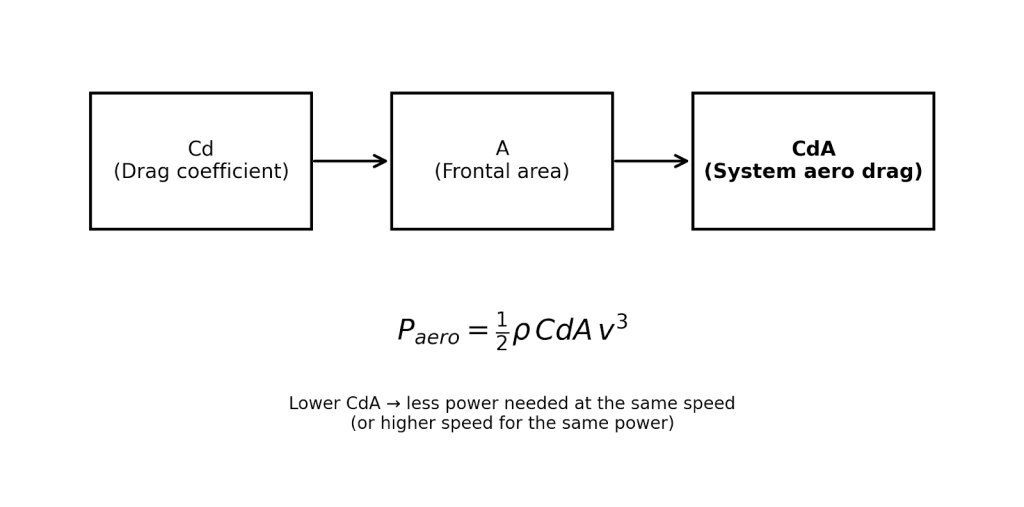
CdA combines two ideas:
Cd (coefficient of drag)
How cleanly air flows around the rider and bike.
Influenced mainly by frame shapes, helmet design, clothing, and surface smoothness.
A (frontal area)
How much of the rider and bike face the wind.
Dominated by rider posture: torso angle, arm width, and head position.
Cd and A are multiplied because both shape and size matter at the same time. A rider can be small but turbulent, or smooth but upright — CdA captures the combined aerodynamic penalty.
The aerodynamic power relationship (important)
Aerodynamic power is calculated as:
P(aero) = 0.5 × air density × CdA × speed³
Written more simply:
Aerodynamic power = 0.5 × ρ × CdA × v³
Where:
• ρ (rho) = air density
• v = speed
This formula explains why:
• Doubling speed requires eight times more aerodynamic power
• Small reductions in CdA create meaningful speed or energy savings
Why TT and triathlon bikes achieve the lowest CdA
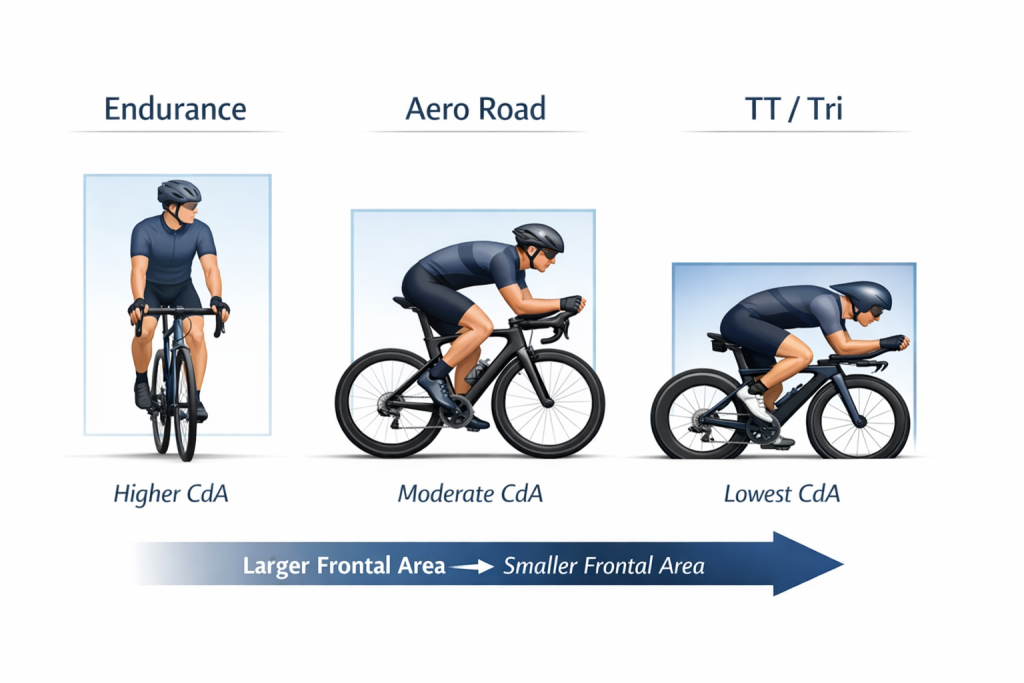
Time trial bikes are fast primarily because they allow the rider to adopt a much smaller frontal area. Aero bars bring the arms closer together, lower the torso, and reduce shoulder exposure. This posture change alone delivers larger aerodynamic gains than most frame upgrades.
Triathlon bikes operate in the same aerodynamic space as TT bikes but are designed for long-distance racing. They prioritise hydration, nutrition, and storage integration while maintaining low drag in real race conditions.
The Argon 18 E-119 Tri+ Disc is notable because its design focuses on maintaining low CdA with race-day equipment installed, not just in a stripped-down wind-tunnel setup.
Aero road bikes: Trek Madone SL 7
Aero road bikes like the Madone SL 7 sit between TT bikes and traditional road bikes. They reduce drag by encouraging a lower torso angle and by shaping airflow around the rider’s legs and wheels.
However, without aero extensions, an aero road bike cannot usually match the CdA of a properly set-up TT or triathlon bike. The rider’s arms remain wider and higher, which limits frontal-area reduction.
Still, compared to endurance road bikes, aero road bikes deliver meaningful aerodynamic improvements at the same power output.
Endurance road bikes: Trek Domane SL 6 Gen 4
Endurance road bikes prioritise comfort, stability, and long-term sustainability. The Domane’s taller front end allows riders to maintain a relaxed posture for hours, especially on rough roads.
The trade-off is aerodynamics. A more upright torso and wider arm position increase frontal area, which raises CdA. This does not make endurance bikes slow, but it does mean they require more power to maintain the same speed when riding solo on flat terrain.
The numbers: 200 watts in the real world
The following comparisons assume:
• Power output: 200 watts
• Terrain: flat road
• Rider + bike mass: approximately 85 kg
• Typical sea-level air density
• No drafting and no wind
Power required to hold 30 km/h
| Bike type | Approximate CdA | Power required |
| TT bike (good position) | ~0.26 | ~118 W |
| Argon 18 E-119 Tri+ Disc | ~0.266 | ~120 W |
| Trek Madone SL 7 | ~0.34 | ~146 W |
| Trek Domane SL 6 Gen 4 | ~0.38 | ~160 W |
Key insight:
At the same 30 km/h speed, a TT or triathlon setup can require around 40 watts less power than an endurance road setup.
Speed at a constant 200 watt
| Bike type | Speed at 200 W |
| TT bike | ~36 km/h |
| Argon 18 E-119 Tri+ Disc | ~36–37 km/h |
| Trek Madone SL 7 | ~34 km/h |
| Trek Domane SL 6 Gen 4 | ~32–33 km/h |
Key insight:
Over long distances, these differences accumulate into many minutes saved, even at moderate power levels.
What really determines CdA
The strongest conclusion is simple:
Rider position changes CdA far more than frame choice.
A well-fitted aero position can save more time than upgrading from one high-end frame to another. Frames refine aerodynamics; posture defines it.
Final takeaway
TT and triathlon bikes achieve the lowest CdA because they allow the rider to become smaller to the wind. Aero road bikes offer meaningful gains without extreme positions. Endurance road bikes trade aerodynamic efficiency for comfort and control.
Choosing the fastest bike depends less on marketing claims and more on how well the bike allows you to maintain an efficient position over time.